Dwarf fruit trees on rootstocks such as M9, P60, or Bud 9 follow the same phenological stages as standard trees — dormancy, bud break, flowering, fruit set, maturation, and leaf fall — but their compact size makes timely intervention easier and more effective. In Poland, the sequence of tasks shifts by two to three weeks depending on whether a garden is in the milder southwest or the colder northeast.

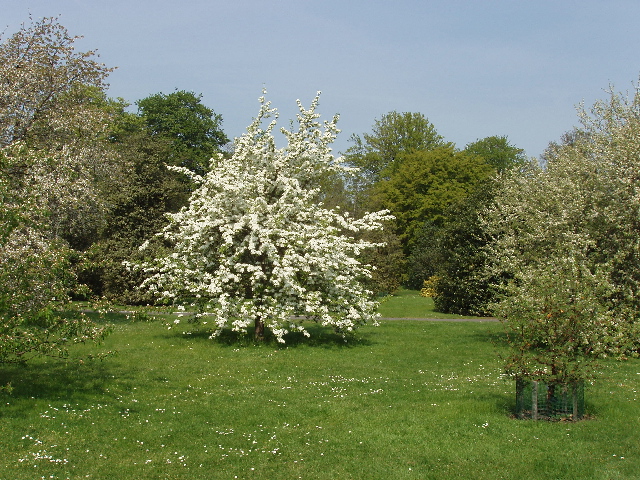
Apple blossom at a Polish-zone spring orchard. Photo: Wikimedia Commons, CC BY-SA 3.0.
Winter and early spring (February – March)
Dormant pruning
The primary pruning window for apple and pear opens in late February, once temperatures reliably remain above −5°C during the day. Pruning before this point risks frost damage to cut surfaces. In the northeast (Białystok, Suwałki region), it is safer to wait until mid-March.
For trees on M9 and P60, the annual pruning objective is to maintain the central leader form, remove crossing branches, and thin fruiting spurs to prevent biennial bearing. Trees that were not pruned the previous year may need a two-year correction programme to restore open canopy structure.
Stake and tie inspection
Dwarfing rootstocks require permanent stakes. After winter, check that stakes have not rotted at the base and that ties have not cut into the bark. Plastic or rubber ties that were installed when the tree was planted can girdle a trunk over a few years if not loosened annually.
Disease management preparation
Apple scab (Venturia inaequalis) overwinters in fallen leaf litter. Raking and removing or composting fallen leaves before bud break reduces the initial inoculum. This is particularly relevant in humid urban microclimates near water features or hedging.
Spring (April – May)
Frost protection during flowering
Flowering in apple and pear typically begins in late April in central Poland (Warsaw, Łódź), and a week to ten days earlier in Lower Silesia. Late frosts are the main spring risk. Open flowers are damaged at −2°C; tight pink bud is resistant down to −4°C.
For individual trees, a fleece cover over the canopy overnight during forecast frosts provides effective protection. Removing the cover during daylight allows pollinator access. For varieties that flower early — such as 'Lobo' or 'Cortland' — frost risk is higher than for late-blooming 'Ligol' or 'Topaz'.
Pollination
Most apple varieties are not self-fertile. At least two compatible varieties — or a crab apple as a polleniser — are needed within 30–50 metres for reliable fruit set. Pears are also largely self-incompatible. Useful Polish nursery catalogues list compatible variety groups; the Research Institute of Horticulture (Skierniewice) publishes updated compatibility tables.
First fertilisation
A balanced NPK fertiliser applied in late April, as leaves emerge, supports early canopy growth and flower development. On sandy urban soils, a split application — half in April, half in June — reduces the risk of nutrient leaching.
Pear tree in blossom. Photo: Wikimedia Commons, CC BY-SA 2.0.
Early summer (June – July)
June drop and fruit thinning
Apple and pear trees naturally shed some fruitlets in early June — a process called the June drop. After this occurs, manually thinning to one fruit per spur (leaving the largest fruitlet) improves final fruit size and reduces the risk of branch breakage under a heavy crop. For trees on M9, a heavy fruit load without thinning can stress the tree sufficiently to cause partial defoliation.
Summer pruning
Light summer pruning in July — removing vigorous vertical shoots (water shoots) that shade the fruiting canopy — improves light penetration and fruit colour development. It also reduces the volume of work needed during dormant pruning the following winter. Summer pruning should be conservative: removing no more than 20% of the canopy in a single season to avoid stimulating excessive regrowth.
Irrigation
Trees on dwarfing rootstocks have a shallow, limited root system and are more susceptible to water stress than those on vigorous rootstocks. During dry periods (less than 20 mm of rain in two weeks), supplemental irrigation of 15–20 litres per tree per week is appropriate. Drip irrigation or a soaker hose around the root zone is more efficient than overhead watering.
Late summer and autumn (August – October)
Harvest timing
Harvest timing for apple depends on variety. Early varieties ('Discovery', 'Sunrise') ripen in August; mid-season varieties ('Jonagold', 'Elstar') in September; late varieties ('Ligol', 'Boskoop') in October. A simple starch-iodine test can confirm maturity if visual cues are ambiguous. Pears are generally harvested before full ripeness and allowed to ripen off the tree.
Calendar summary
- February–March: Dormant pruning, stake inspection, leaf litter removal
- April–May: Frost protection, fertilisation, pollination check
- June–July: Fruit thinning, summer pruning, irrigation management
- August–October: Harvest, second fertilisation (potassium), autumn soil work
- November–December: Protective wrapping, rodent guards, tool cleaning
Autumn fertilisation
A potassium-dominant fertiliser applied in September supports wood ripening and winter hardiness. Avoid nitrogen applications after mid-August, as these stimulate soft growth that is susceptible to frost.
Winter preparation (November – December)
Before hard frosts, young trees and those in exposed positions benefit from wrapping the lower trunk with a spiral tree guard or hessian to prevent frost cracking and sun-scald. Rodent damage — rabbits and field mice chewing bark at the snow line — is common in suburban Polish gardens. A physical guard around the trunk base to a height of 50–60 cm is effective.
Garden tools should be cleaned and blades oiled before storage. Pruning saw blades that are not cleaned between trees can carry scab and canker spores; wiping with a dilute bleach solution between cuts is recommended during active disease seasons.
Sources
Phenological data for Polish apple and pear varieties referenced from publicly available documentation by the Research Institute of Horticulture, Skierniewice. Last frost dates from IMGW-PIB historical station records.

